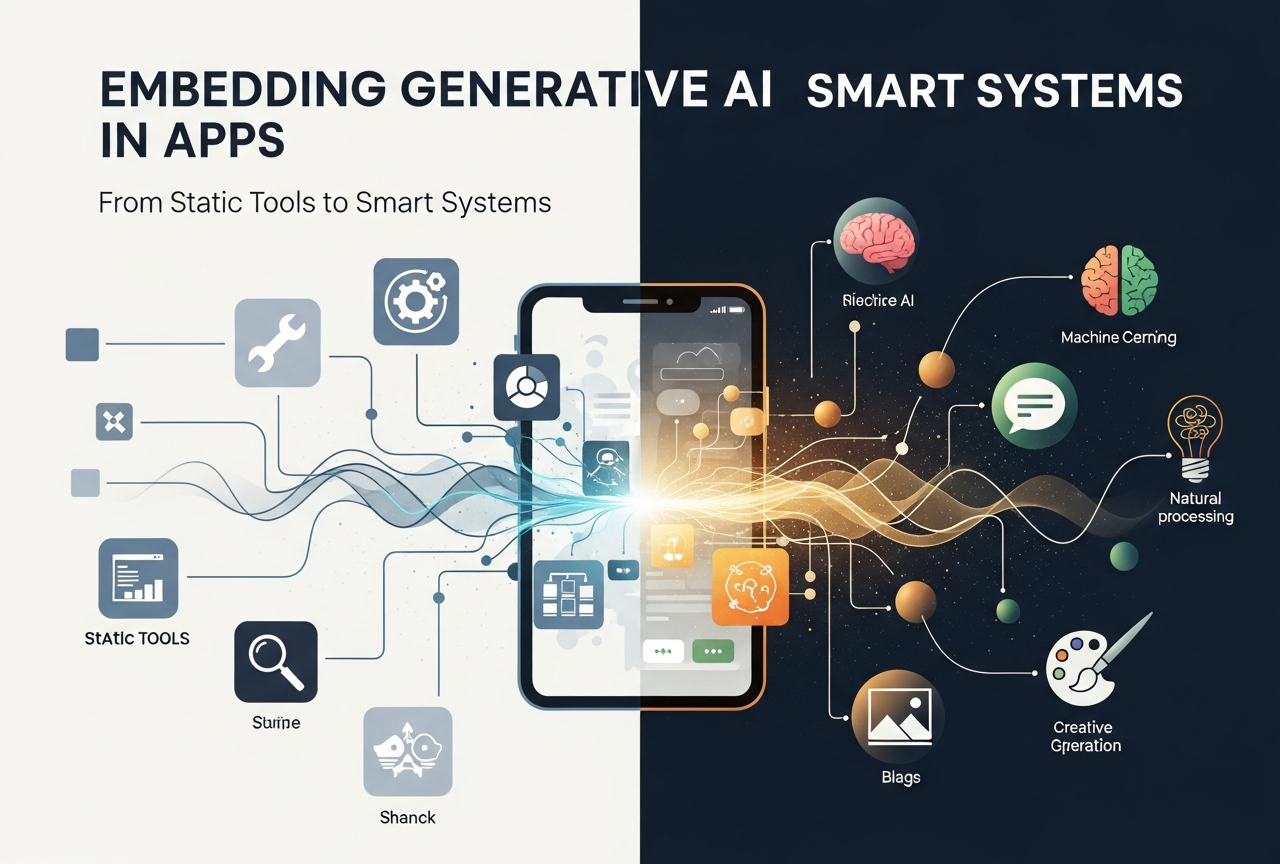
A few years ago, most apps behaved like polite, rule-following robots, doing exactly what you told them and nothing beyond that. They operated on fixed workflows and long-established scripts, totally unaware of users’ shifting needs or intentions. But now, we’re watching a massive transformation unfold. Apps are no longer static; they’re becoming adaptive, conversational, and surprisingly intuitive.
The force behind this leap is generative AI, especially the rise of embedded gen AI applications that weave intelligence directly into everyday software. Instead of being isolated “AI add-ons,” these systems act like the quiet brains inside apps, making them smarter, more predictive, and almost eerily aware. And yes, this shift is accelerating faster than anyone expected.
From Fixed Logic to Fluid Intelligence
Traditional applications are based on established protocols that dictate specific responses to particular events. For instance, if condition X occurs, then action Y is executed. This approach is undoubtedly beneficial; however, it tends to be inflexible, predictable, and somewhat simplistic. With embedded gen AI applications, that rigidity melts away. Apps can:
- Interpret user intent
- Learn from patterns
- Generate responses dynamically
- Offer personalized recommendations
- Adapt workflows automatically
Imagine a project management tool that rewrites tasks based on team behavior, or a CRM that auto-drafts personalized follow-up messages using contextual cues. It’s not just automating; it’s thinking alongside you. If older apps were like calculators, today’s AI-powered systems feel more like collaborators.
Why Generative AI Is Becoming a Must-Have inside Modern Apps
Every digital experience is evolving. Whether you’re building a fintech product, a learning platform, or some oddly specific workflow tool, embedding generative AI unlocks massive advantages.
1. Instant Personalization
Apps can respond differently to each user. No more one-size-fits-all dashboards, your interface literally reshapes based on your patterns.
2. Reduced Cognitive Load
People don’t want to click through 12 menus. They want to type, “Summarize my analytics for last quarter,” and get an answer in seconds.
3. Faster Feature Deployment
With generative components doing some of the heavy lifting, builders can iterate rapidly, even using a low code app builder or complex app builder to scale functionality with far fewer development hours.
4. Competitive Advantage
Let’s be honest: if your competitor’s app “thinks” and yours doesn’t, well, that’s not a small gap. Generative AI isn’t a bonus anymore; it’s part of the foundation.
The New Development Stack: AI at the Core, Not the Edges
The traditional model of application development considered artificial intelligence as an ancillary component. It was characterized by the approach of, "We will construct the application and potentially integrate an AI assistant at a later stage." However, this perspective now appears to be outdated. Modern builders, especially those using tools like a complex app builder or a low-code app builder, are starting with AI at the architectural level.
What does that look like?
- Data flows are structured for continuous learning
- User actions feed adaptive models
- Prompts replace rigid workflows
- Interfaces evolve based on intent
It’s not about attaching intelligence; it’s about designing intelligence-first systems from scratch. This AI-native development mindset changes everything, how apps are planned, built, and experienced.
A Quiet Revolution Inside No-Code and Low-Code Platforms
Here’s something surprisingly refreshing: even non-technical creators can now build AI-driven applications.
Modern platforms combine natural language interfaces with powerful automation engines. Whether someone uses a free online app builder, a beginner-friendly low code app builder, or a more advanced complex app builder, generative features are accessible with minimal friction.
You can literally say: “Generate a customer onboarding workflow that adapts based on user responses.”
The system will create it: logic, UI, and all. This accessibility is creating a small revolution among founders, freelancers, educators, and DIY builders who thought AI was out of reach.
Real-World Examples of Embedded Generative AI at Work
The shift isn’t theoretical. Here are a few real patterns emerging across industries:
1. Smart Dashboards That Rewrite Themselves
Analytics platforms regenerate insights using natural language summaries, turning complex data into daily digestible narratives.
2. Intelligent Knowledge Assistants
Apps can create help articles, explain features, or guide users through workflows without human-written documentation.
3. Adaptive Learning Paths
EdTech platforms use AI to generate personalized lesson plans based on user pace and performance.
4. AI-Aware Automation Engines
Instead of rigid triggers, apps can decide the best action based on context, tone, or predicted outcome.
This is exactly why embedded gen AI applications are becoming the new core of modern software, not optional add-ons.
The User Experience Shift: Apps That Understand Mood, Not Just Input
One fascinating (and slightly spooky) change is emotional adaptation. Many AI-driven apps now detect tone and intention.
If a user types, “This interface is too messy,” the system might instantly suggest layout improvements. If they say, “Help me simplify this flow,” the platform rewrites the workflow.
This is the move from mechanical UX to conversational UX, from tools that react to tools that understand.
With a free online app builder or a flexible low code app builder, creators can now implement features that used to take months of R&D. It feels futuristic, but it’s already here.
Is AI Replacing Traditional Logic-Based Design? Not Exactly; It’s Redefining It
Static logic isn’t disappearing; it’s blending with dynamic intelligence. Developers and creators now mix:
- Predefined rules
- Generative models
- Natural language prompts
- Real-time learning loops
The result is apps that behave consistently but adapt when necessary. It’s like giving your software both a skeleton and a brain.
For teams using a complex app builder, this hybrid approach significantly reduces the development burden.
Why Businesses Are Adopting AI-Native Systems at Record Speed
The appetite for intelligent apps is exploding because organizations want:
- Faster deployment
- Scalable functionality
- Lower costs
- Automated workflows
- Better customer experiences
With generative AI embedded directly into systems, companies can produce results that once required entire engineering teams.
Even non-technical teams, from operations to marketing, now build smart internal tools using free online app builder platforms or low code app builder solutions. The capability uplift is enormous.
Workmaster: Redefining How AI-Native Apps Come to Life
At Workmaster, we believe building intelligent applications shouldn’t be restricted to experienced developers. Our platform combines the power of a complex app builder with the simplicity of a conversational interface. From fully automated workflows to dynamic interfaces and real-time AI-driven responses,
Workmaster enables you to build truly embedded gen AI applications without getting tangled in code. You describe the idea; we translate it into functional logic, UI, and deployment-ready architecture. Whether you're creating internal tools, automating business operations, or designing sophisticated user-facing products, Workmaster acts as your AI-powered development partner. Explore how easily you can build smarter systems at Workmaster.ai.
Frequently Asked Questions
1. What are embedded generative AI apps?
Apps with integrated AI capabilities that analyze context, generate responses, and personalize experiences dynamically.
2. Do I need coding to use generative AI?
No, modern low-code and no-code tools enable seamless generative AI usage without programming expertise.
3. How does AI improve app experience?
AI provides personalization, automation, adaptive interfaces, and intelligent guidance based on real-time user behavior.
4. Why should businesses embed generative AI?
It streamlines operations, automates tasks, enhances decision-making, and accelerates digital transformation across teams.
Related reading
AI app builder · Natural Language to Application: The Rise of AI-Native Builders · Exploring the Role of LLMs in App Creation Without Developers