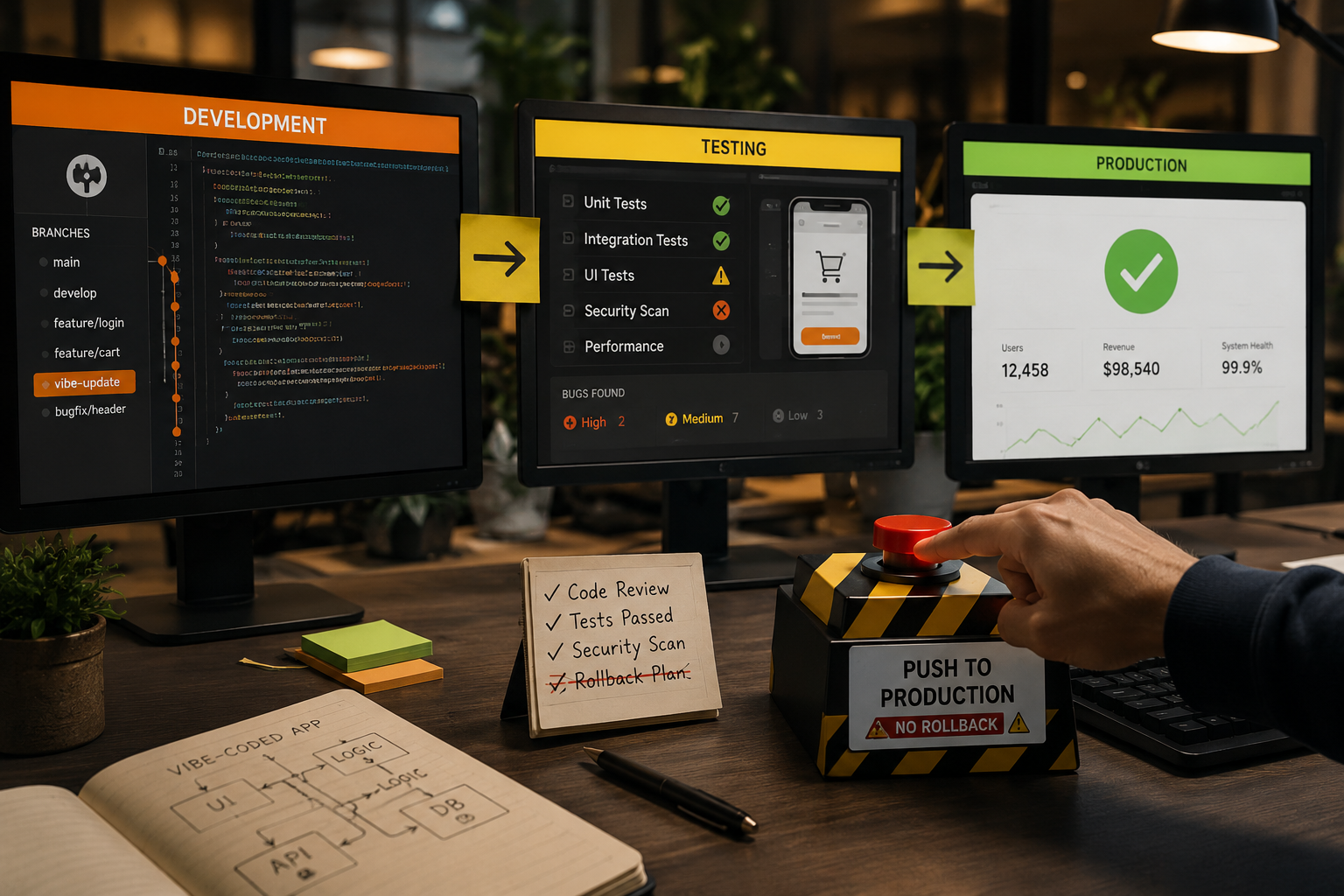
Many online services now allow a novice user to generate apps of varying complexity. After going through quite a few, I’ve noticed that many focus on the development aspects of the app. They ignore what’s needed to run the app in a real business environment.
This is fine the resulting app is for a startup that doesn’t have an existing customer base, or wants to trial a new idea quickly. But what if you are an established business with existing clients or customers? In this case, you need many of the following features or services:
A way to control changes in the app (Version management) so the next changes of vibe coding doesn’t break what’s working right now
A way to test an app with sample data and documents, but without that data ‘mixing’ in with the real data that’s used to run the business.
Business-grade Vibe-coding environments that are NOT just aimed at programmers or technical people, really need to provide a robust, easy to use and understand features that provide all of the above. At a bare minimum, this means the ability to version control changes – if there is a problem with a new version, it should always be possible to ‘roll back’ to an earlier version.
Another vital service that needs to be present, is the ability to run multiple environments. So you can develop you changes vis vibe coding in one environment, test in another, and deploy the tested app in the final ‘production’ environment.
Without such capabilities ,a vibe coding platform will remain a useful prototyping tool, but business will still need to rely on experienced IT staff to manage testing and deployment.
Fortunately, modern Vibecoding platforms designed for non-technical business users, are now providing such features. Version control with the ability to switch versions, and merge in new code without breaking old versions (The best ensure backward-compatibility in the structure of the app, ensuring new features do not break the ability to work with older data). They also provide two or more environments, each with its own configuration management, data stores – even the level of service capability – that is appropriate to each environment.
Dangers of Vibe-Coded Apps
An Exploration of Risks and Requirements for Business Use
Dangers of Vibe-Coded Apps
In recent times, many online platforms have made it possible for novice users to create apps of varying levels of complexity. Through exploring several of these services, it becomes evident that most place their emphasis on the development phase of the app, often neglecting crucial elements needed to successfully operate the app in a real business setting.
Considerations for Established Businesses
While a development-focused approach may suit startups with no existing client base or organisations wishing to rapidly trial new concepts, the requirements are very different for established businesses that already serve customers. In these instances, the following features and services are essential:
- Version Management: A robust mechanism for controlling changes within the app is vital. Without proper version management, updates made through vibe coding may inadvertently disrupt existing functionalities that are currently working well.
- Testing with Sample Data: There must be a facility to test the app using sample data and documents, ensuring that test data does not intermingle with genuine business data used in day-to-day operations.
Requirements for Business-Grade Vibe-Coding Platforms
Business-grade vibe-coding environments, particularly those designed for users without technical backgrounds, must offer features that are both reliable and intuitive. At a minimum, these platforms should provide version control, allowing users to revert to earlier versions if issues arise with recent updates. This ensures that if a new release causes problems, it is always possible to restore a previous stable version.
Another indispensable feature is the ability to operate across multiple environments. This enables businesses to develop changes in one environment, carry out testing in a separate environment, and finally deploy the thoroughly tested app in a dedicated production environment.
Limitations Without Essential Features
In the absence of such capabilities, vibe coding platforms will remain useful for prototyping. However, businesses will still need to rely on experienced IT staff to oversee testing and deployment processes.
Advancements in Modern Vibe-Coding Platforms
Fortunately, newer vibe-coding platforms aimed at non-technical business users now offer the necessary features. These include version control, with the ability to switch between versions and merge new code without breaking previous versions—ensuring backward compatibility and maintaining the app’s ability to work with older data. Additionally, these platforms provide multiple environments, each with its own configuration management, data stores, and service capabilities suitable for its specific use.
Related reading
AI app builder · Guarding Against AI Jailbreak · The Importance of Access Control with AI