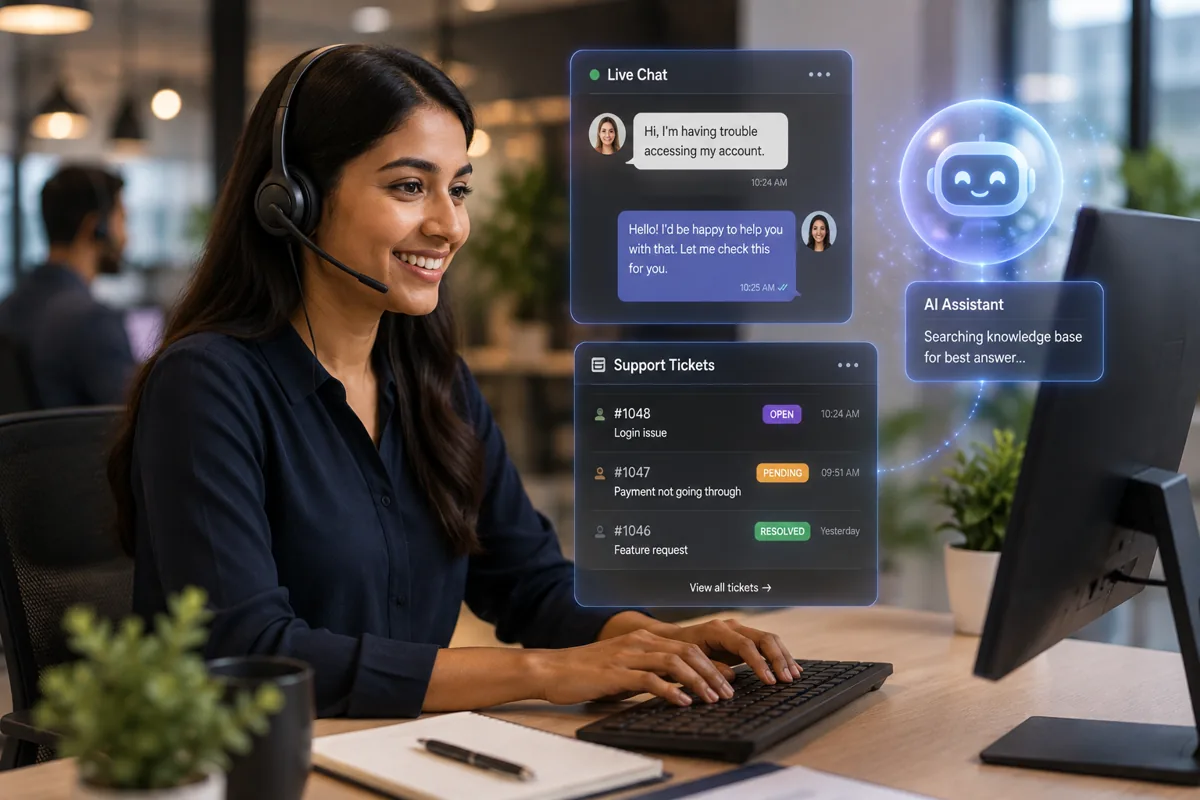
What Is an AI Agent in Customer Service?
An AI agent for customer service is software that reasons through a customer's request, pulls live data from systems like your CRM (customer relationship management platform), order management, or knowledge base, and resolves multi-step problems on its own without a human needing to look anything up manually.
This is a meaningfully different animal from the chatbots you dealt with five years ago. Older bots ran on scripted decision trees: if the customer typed "refund," the bot served a canned response and hoped it matched. Current AI agents operate on reasoning. They read the full context of a conversation, pull relevant data from multiple connected systems at once, and can chain together several steps (checking an order status, confirming a return policy, issuing a credit) without bouncing the customer to a human, according to AI for Customer Service 2026 Costs ROI and Rollout Plan.
Adoption Is Moving Fast
The category has gone from novelty to standard infrastructure in a short window. Industry surveys show the share of service teams running AI agents jumped from 39% to 66% in a single year, and roughly seven in ten teams that deployed agents reported measurable value within 60 days.
But adoption is often top-down. According to Customer Service AI Use Cases, 91% of customer service leaders report executive pressure to implement AI-driven solutions. That matters, because rollouts with a deadline attached often skip the groundwork that makes them work, which is exactly why some deployments deliver real value and others quietly stall.
Keep a Human in the Loop
AI agents deliver the most value when they support a human agent's judgment rather than try to replace it outright. Daniel Lawson of Verizon Business put it plainly:
"AI is most effective when human agents can use it as a 'sixth sense' or as an 'angel on the shoulder,'" according to AI delivers the best customer support when it's enhancing humans, study finds.
The strongest deployments treat the AI as a co-pilot: it surfaces the right account history, suggests a next step, or drafts a response for a human to review and send, while a person keeps the judgment calls on the messy 20% of interactions that don't fit a template. The angry customer, the ambiguous policy exception, the multi-department escalation: those still belong with a person.
How Workmaster Runs This as an AI Virtual Employee
In Workmaster, an AI agent for customer service is set up as an AI virtual employee that runs real, multi-step processes, not just a chatbot that replies. Each process is a defined workflow the agent can carry out end to end.
Take a common example: a customer messages to return an item. The virtual employee runs the return process on its own. It checks the order, confirms the item is within the return window and policy, generates the return label, and updates the order status, then confirms back to the customer. Another everyday one: a customer wants a call back, so the agent schedules the callback, captures their number and reason, and books it into the right person's calendar.
What keeps this safe is that Workmaster process steps can be semi-autonomous. The agent does the work automatically, but for the steps that matter it pauses for a human to see what is waiting and approve it. A refund above a set value, or an unusual return reason, is held for a team member to review and approve in one click. The AI removes the repetitive work; a person keeps the final say on the decisions that count.
That is the practical difference between a chatbot that talks and a virtual employee that works: it understands the request, runs the process, and knows when to bring in a person.
Getting It Right
Technology is rarely the reason AI agent rollouts stall. According to PwC's AI Agent Survey, the biggest barrier isn't the technology; it's mindset, change readiness, and workforce engagement. A short checklist to avoid the common traps:
- Involve frontline agents early. They know where customers get stuck and where scripted logic breaks down.
- Audit your data quality before launch. An agent pulling from stale CRM records or incomplete order histories will make confident, wrong answers.
- Define escalation paths clearly. Customers need to know how to reach a human, and the AI needs to know when to hand off.
- Align the rollout with a specific goal (faster first response, lower cost per ticket, higher first-contact resolution) rather than deploying AI for its own sake.
Related: Explore the no-code AI platform for small business, or see AI virtual employees in Workmaster.
Frequently Asked Questions
Does an AI agent replace human customer service reps?
No, not in most current deployments. The strongest results come from AI supporting human agents and running routine processes, while people handle complex or sensitive cases.
Can an AI agent actually complete tasks, not just answer questions?
Yes. With a platform like Workmaster, the agent runs full processes, such as booking a return, scheduling a callback, or updating an order, and pauses for human approval on the steps that need it.
What's the biggest reason AI agent rollouts fail?
Workforce mindset and change readiness, not the underlying technology. Surveys consistently point to organizational buy-in, training, and alignment with business goals as the deciding factors.
How fast can a company see results from an AI agent deployment?
Many teams see measurable value within about 60 days, though results depend heavily on data quality, integration depth, and how well staff are trained to work alongside the tool.
Example: a subscription box company
Picture a subscription snack box with a two-person support team. A customer messages that this month's box never arrived. The AI agent reads the order, sees the tracking is stuck, and follows the process the business defined: it apologises, offers a reship or a credit within the limit set, and updates the order, all without a human. A second customer wants to cancel; because cancellations are a save opportunity, that conversation is routed to a person with the full history attached. The routine gets handled instantly; the judgement call reaches a human with context.
Where This Leaves You
If you're evaluating an AI agent for your service team, start by auditing your data quality and your escalation paths before you touch a vendor demo. The technology itself is rarely what breaks a deployment; skipping the unglamorous groundwork is. And look for a tool that does more than reply, one that runs your actual processes and keeps a human on the decisions that matter.
References
- customerexperiencedive.com, AI delivers the best customer support when it's enhancing humans, study finds
- pwc.com, PwC's AI Agent Survey
- gartner.com, Customer Service AI Use Cases
- tommasomariaricci.com, AI for Customer Service: 2026 Costs, ROI and Rollout Plan
Related reading
business process automation · AI Customer Service Automation: Do More Without Hiring More · Custom AI Chatbot Builder for Your Business (No Code)