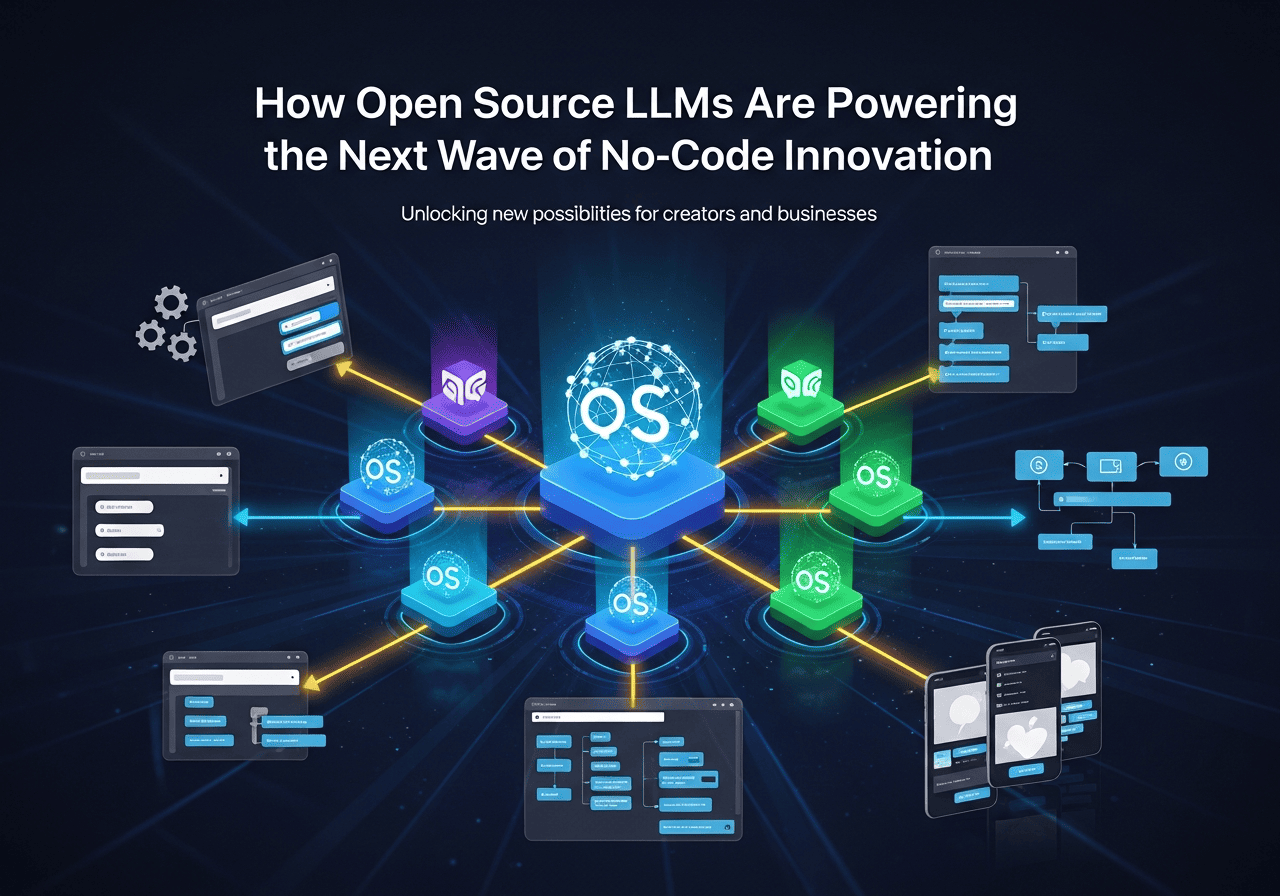
The way digital products are built is quietly changing, and it’s not just developers who are noticing. Today, founders, marketers, and operations teams are creating functional applications without touching traditional code. This shift is largely driven by Generative AI and the rapid maturity of Open source LLMs, which are making intelligent automation more accessible than ever. Combined with modern no-code platforms, these technologies are lowering technical barriers and opening the door for faster experimentation. What once required weeks of development can now start with a simple idea and a few guided steps.
Understanding the Role of Open Source LLMs in No-Code Platforms
No-code platforms already simplify application creation through visual tools. But when Open source LLMs are added to the mix, the experience becomes far more intuitive. These models understand natural language, context, and intent, allowing users to describe what they want instead of manually configuring every detail.
Unlike closed systems, open-source models can be customized, audited, and improved by a wider community. This flexibility makes them ideal for no-code environments where adaptability matters. Teams can fine-tune models for specific workflows, industries, or languages without being locked into rigid frameworks. As a result, no-code platforms become smarter, more responsive, and better aligned with real business needs.
Ways Open Source LLMs Are Powering the Next Wave of No-Code Innovation
1. Natural Language App Creation
One of the most visible changes is how apps are now created using plain language. Instead of navigating complex menus, users can simply describe what they want the app to do. Open-source language models interpret these instructions and translate them into workflows, data structures, and interfaces. This removes much of the technical friction and makes building feel more conversational and human.
2. Intelligent Workflow Automation
Open-source LLMs help no-code tools move beyond static logic. They can analyze inputs, understand patterns, and suggest actions automatically. This means workflows can adapt based on context rather than following fixed rules. For businesses, this leads to smarter automation that feels less robotic and more aligned with real-world scenarios.
3. Faster Prototyping and Iteration
Speed is a major advantage of no-code platforms, and Generative AI takes it further. By generating layouts, logic, and even test data, LLMs allow teams to prototype ideas in hours instead of days. Because the models are open source, platforms can iterate quickly, experimenting with new features without waiting for vendor updates.
4. Smarter AI Productivity Tools
Many modern AI productivity tools rely on open-source language models to assist users during the build process. These tools can explain features, suggest improvements, and even detect potential issues before deployment. For non-technical users, this guidance feels like having an assistant quietly helping in the background, which boosts confidence and reduces errors.
5. Adaptive User Experiences
Open-source LLMs also enhance how end users interact with no-code apps. Chat-based interfaces, smart forms, and contextual help features are becoming common. These experiences feel more natural because the AI understands intent, not just clicks. Over time, this leads to apps that evolve based on user behavior rather than staying static.
6. Cost-Effective and Scalable Innovation
Using open-source models helps reduce dependency on expensive proprietary APIs. This makes no-code platforms more affordable and scalable, especially for startups and growing businesses. Builders can experiment freely without worrying about unpredictable costs, which encourages innovation and long-term adoption.
7. Empowering Non-Technical Builders
Perhaps the biggest impact is who gets to build. With open-source intelligence embedded into every step, no-code tools empower designers, analysts, and business users to create meaningful applications. The app builder becomes a creative workspace rather than a technical challenge, reshaping how teams collaborate.
Ready to turn ideas into AI-powered apps? Build something amazing with Workmaster.
Start For FreeThe Bigger Picture for Businesses and Teams
As no-code platforms evolve, they’re becoming strategic assets rather than simple tools. Businesses can respond faster to change, test ideas internally, and launch customer-facing solutions without heavy development cycles. With AI productivity tools powered by open-source LLMs, teams spend less time managing complexity and more time refining outcomes.
This shift also reduces the gap between idea and execution. When tools understand language and intent, innovation becomes more inclusive. That’s the real promise of combining Generative AI with no-code technology; it turns creativity into something actionable, not theoretical.
How Workmaster Supports AI-Driven No-Code Innovation
At Workmaster, we focus on helping people build applications without technical roadblocks. Our no-code app builder is designed for founders, teams, and enterprises who want speed without sacrificing flexibility. We combine intuitive drag-and-drop design with built-in AI capabilities that simplify workflows and automation.
From internal tools to customer-facing apps, Workmaster helps users move from idea to execution smoothly. Our platform integrates smart assistants, automation features, and scalable architecture so applications grow as your needs evolve. We believe innovation should feel approachable, and with Workmaster, building powerful digital solutions becomes a practical, everyday process rather than a complex technical task.
Frequently Asked Questions (FAQs)
What makes open source LLMs important for no-code platforms?They enable natural language understanding, flexibility, and customization, making no-code app development faster and more accessible.
How do open source LLMs reduce development time?They automate logic creation, workflow setup, and content generation, allowing users to build and iterate applications rapidly.
Can non-technical users really build apps using AI-powered no-code tools?Yes, intuitive interfaces and AI guidance help non-technical users create functional, scalable apps without coding knowledge.
Are AI-powered no-code apps scalable for business use?Most platforms support scalable architectures, enabling apps to grow alongside business demands and increasing user volumes.
How do AI productivity tools improve everyday workflows?They automate repetitive tasks, provide smart suggestions, and adapt processes based on context, improving efficiency and accuracy.
Related reading
AI app builder · Reimagining No-Code: How AI App Creation Uses LLMs to Automate Everything · From Prompt to Production: How LLMs Now Generate Full AI Apps Without Coding